
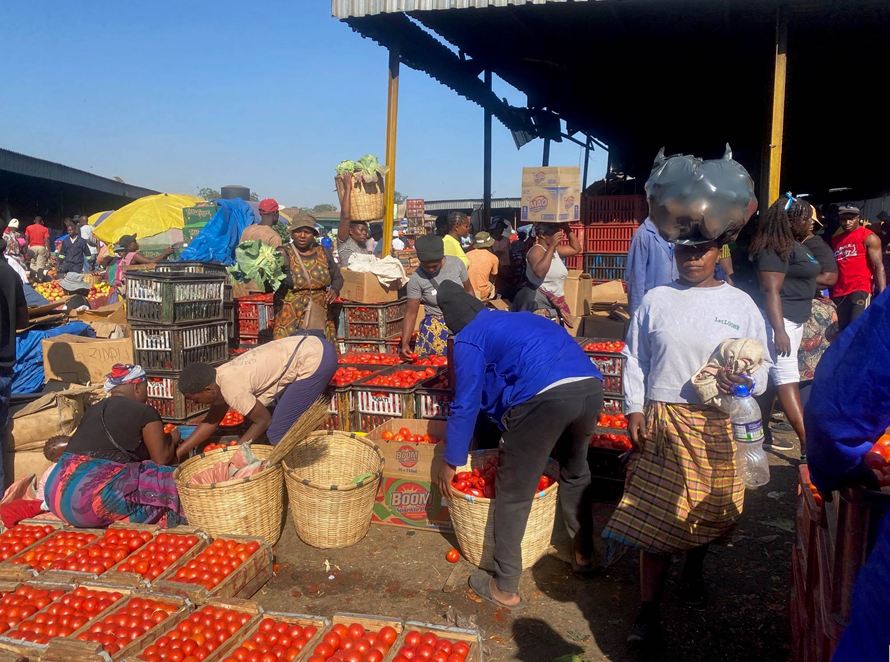
Unlike abstract elite markets such as the stock market, African mass markets are more inclusive hyper-active ecosystems where farmers, traders, vendors, processors, transporters, different consumer classes and various service providers actually trade. Dealing with diverse structural surprises and underestimations has enabled these actors to live complex financial realities every day. They have their own unique ways of managing currency fluctuations, climate variability, unpredictable utility costs, and difficulties in accessing to credit.
Price discovery is informed by diversity
Due to the complexity of the mass market, the actors are not just satisfied with simplified stories like the price of a single commodity. Instead, diversity influences price discovery as the mass markets provide price ranges informed by different factors like variety, quality, size and source. More important are conversations on what people see including questions from users. Some consumers may want to know the characteristics of low-grade tomatoes or organic eggs. It is through dealing with all these dynamic issues that mass market silently mobilize transformation within food systems. More than price information, most actors need clear explanations of complex market dynamics like how seasonality and competition between mango fruits and tomatoes influence consumer choices. Mass market actors are always managing real businesses and handling agribusiness analysis beyond generic information. Some market dynamics are not explained by the laws of supply and demand so, the mass market provide recommendations, comparisons, and synthesized answers, not just prices.
The power of understanding decision moments
Unless policy makers, investors and development agencies have privileged access to decision moments within mass markets and behavioural data they may not be able to make sense of relationships between farming communities and mass markets. Interacting with thousands of farmers, traders, vendors and consumers can enable pattern recognition around human behaviour within mass markets. Such behaviour is tied to the salient trading template comprising information like prices; commodity types and varieties; grades; sources; quantities including different measurements like Semia, Crown, Dengu, bundle and many others.
Mastering decision moments and market behavioural patterns can enable government interventions and other food systems investments including irrigation schemes to be streamlined so that they respond to demand through market calendars. In most cases, these initiatives just promote the planting of crops irrespective of whether there are buyers for surplus commodities or not. In some communities, irrigation schemes underperform during the rainy season because farmers move to dryland farming where the food basket is broader including sweet reeds, diverse melons that are not produced under irrigation.
Besides preparing farmers for the next farming season, working with mass markets can enable policy makers to rebuild the confidence of farmers, traders and consumers in the agriculture sector and food system. It can also open new career path for young people so that they begin to capture and document indigenous farming knowledge from elders who are the main source. That way, they preserve the history of each farming community and mass market for future generations. The pace of urbanization and modernization is leading to the disappearance of rural areas and their Indigenous Knowledge Systems (IKS). Knowledge provides a strong foundation for innovation and growth. However, such efforts cannot start with ICTs without knowledge from the source.
Supporting policy processes and enhancing commodity values
When properly supported, mass markets can enhance policy processes to ensure stability, transparency and economic justice. They can also improve transparency, not only in giving farmers better prices, but also enhancing the value of commodities. After producing, to what extent can farmers recoup their costs? Input costs remain the same. What systems are there for farmers to recover their costs? Unfairness takes advantage of where the farmer has come from to arrive at the market and how s/he makes a decision. Unfairness is being facilitated by the absence of a system that can help farmers to make a decision before travelling 300km to the market with a commodity.
Suppressed prices reduce the value of agricultural commodities and shrink the economy. When prices are suppressed, the value of agriculture and commodities go down, causing the whole economy to shrink. Where a farmer gets $15 000 instead of $20 000, it means his/her planting area goes down by $5000 next season. Data from the mass market can reveal how every action has a lot of impacts on the performance of the agriculture sector. If questions from farmers, traders and other actors who directly affected by market performance, it means government has no system for collecting data and answering those questions. AI or drones cannot answer those questions. By enhancing the value of agricultural commodities, mass markets can see farmers earning twice and getting good Return on Investment in ways that trigger more production.
The mass market as an investment guide
If more than 70 percent of a country’s food basket passes through the mass market, improving the state of mass markets opens 70 percent of the country’s agriculture to the world. The mass market becomes a national platform that is able to consolidate knowledge and information across the food system toward improving decision-making and performance of agricultural-driven economies. It also becomes an investment guide for value chain actors, government, financiers and development agencies. In many African countries, the slow pace of data and information access slows down economic growth. It also reduces the rate at which money circulates. When the market is disorganized, customers spend hours looking for what to buy.
When the mass market is well-organized it becomes an efficient system that can sell commodities valued at $100 within 10 minutes. If the mass market has commodities worth $100 000 and buyers collectively bring $50 000, it means a $1 will buy commodities worth $2. At the end of the day $100 000 can generate five times the value of market. Increasing the velocity of money through digital technology which extends commodities to other markets multiplies benefits.
Charles@knowledgetransafrica.com / charles@emkambo.co.zw /
Website: www.emkambo.co.zw / www.knowledgetransafrica.com
Mobile: 0772 137 717/ 0774 430 309/0712737430