
How can African countries hope to make the African Continental Free Trade Area (AfCFTA) work when there are no systems to facilitate trade within countries and between neighboring countries? African countries cannot succeed on the regional and global market stage when local trading is fragmented due to absence of reliable systems. Without data and evidence systems African countries cannot value their natural resources or assess the performance of the agricultural sector accurately.
So far, the countries rely on estimates from the production side in terms of tons harvested. But what is the value of those tons as determined by the markets? If 10 000 tons have been produced, how much have been generated and how much revenue has been generated which can be translated to contribution to GDP and GNP? There is a big ga because more than 70 percent of agricultural trading has not been systematized. Government only talks about figures delivered to GMB. What about quantities going to the mass markets? More trading is happening in mass markets but there are no national systems for capturing those trading dynamics and amount of money exchanging hands in those ecosystems.
Using data to build business models
Characteristics of crops and livestock that do well naturally in particular regions are now known. In regions where particular crops do well, there is often a glut of those commodities in a season but short supply in other regions. How is that information packaged and shared between low producing regions and high producing regions in order to connect the two regions and build business models around that knowledge and information? One farmer might be struggling with selling 10 000 cabbages but one market in a part of the country has no cabbages. This is because African countries are still stuck with traditional systems of sharing information. For instance, most African countries are lagging behind self-organized systems in territorial mass markets. Information and knowledge are in diverse silos.
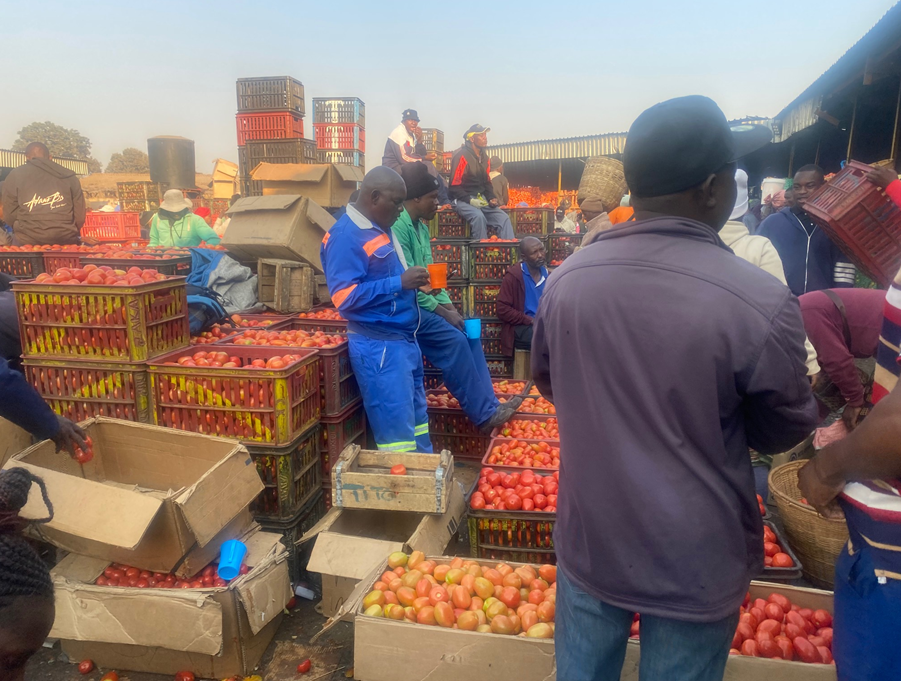
How does someone in Hwange or Lupane know about commodities in Mbare and get what she wants without going to Mbare? In most cases, by the time farmers get information about buyers, the commodity that was ready for the market has gone bad and no longer marketable or consumable. Information asymmetry and information/knowledge silos have existed for decades. That has continued to slow down the business performance of supply chain actors like farmers, traders and vendors. A sudden and unknown increase in tomato prices due to shortages, disrupts the budgeting process for food vendors and slows down uptake of commodities. For vendors, how a commodity is sold matters affects profitability and ability to continue in the business. When vendors get to the market and find a tomato crate that was going for $40 yesterday now at $45, that means they have to revise their scale of selling methods from $1 for 10 to $1 for 5 tomatoes. It will take time for consumers to those new portions and that decision-making process slows down the uptake of tomatoes in the market as negotiations take longer while the commodity is also losing value.
What is informing production practices?
Much efforts by government, development organizations and private companies have been on the production side, but what is informing that production, quantities to be produced and for who? Lack of timely data gathering and sharing is affecting the agriculture sector. There are no organized systems and institutions supporting the production side from the market in order to build strong business models. When there is no business sense in farming, agriculture and food systems are threatened. Many farmers lose hope and stop farming. That is why establishing a data gathering and sharing system is key in solving enabling real-time decisions without being resource-heavy for value chains.
Transforming markets through digital solutions
All these gaps call for digital technologies. Drones can fly around mass markets and borders to show an aerial view of what is happening but cannot capture what is really happening in the trading processes in terms of who is buying what, which commodities are being bought more and at what price? A real transformation will be brought by establishing a digital market place that is connected to physical markets. The digital platform will eventually translate what is being traded physically to be visible on the digital market place. Someone in Gwanda should see what is being traded in Mbare and make an order immediately without spending five days looking for a particular commodity.
Charles@knowledgetransafrica.com / charles@emkambo.co.zw /
Website: www.emkambo.co.zw / www.knowledgetransafrica.com
Mobile: 0772 137 717/ 0774 430 309/ 0712 737 430