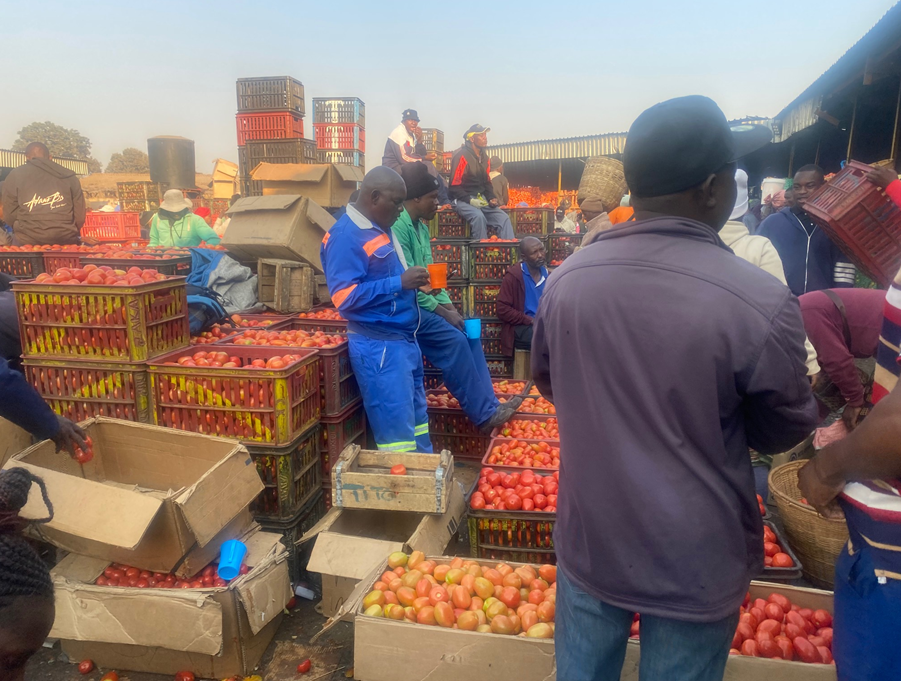

African leaders who really care about food systems transformation cannot ignore what is happening in the mass market. Ignoring these markets is ignoring more than 70 percent of actors who handle food after it has been produced. In most African countries, mass markets or territorial markets are the true centre of gravity for local food systems. And their influence continues to grow as shown by how they are creating space for marginalized indigenous foods to muscle their way into national, regional markets, all the way to the diaspora where many Africans miss what they grew up eating.
Broadening nutrition baskets
If urban consumers relied entirely on supermarkets, their diets would be too narrow and monotonous. Instead, mass markets quietly close this gap by providing a broad and culturally-appropriate food basket season by season. When an indigenous fruit is in season, urban and rural consumers feast on it so much that when it gets out of season, they won’t miss it much. With consciousness about eating health gaining attention from many urban consumers, indigenous fruits are beginning to insert themselves in consumer choices and conversations on micronutrient deficiency. Research on the contribution of indigenous natural foods to nutrition balance is still lagging behind. But broad availability of these foods in cities which did not use to be the case a few decades ago is influencing dietary and nutritional shifts that policy makers should not ignore.
Silently decolonizing food systems
By creating space for diverse indigenous food, mass markets are decolonizing African food systems. They are bringing indigenous food to urban kitchens, dinner tables, restaurants and events like weddings. As urban consumers fast acquire natural tastes. indigenous food is no longer just associated with events like Africa Day celebrations. Governments might still be pushing industrial high inputs agriculture but mass markets are mobilizing climate-friendly and less costly production and consumption patterns. Consumers are becoming aware that distances covered by food from production to markets have a bearing on sustainability and climate change.
When mass markets provide space for food produced locally, they give local farmers more autonomy and power to control production practices and consumption patterns in more climate-friendly ways. The way mass markets work and their tightly inclusive characteristics have made it difficult for corporate supply chains to dilute or destroy them. Instead, most corporate supply chains have been forced to learn from mass markets in order to introduce formal practices without undermining mass markets. That is why most people who talk about formalizing mass markets and financial inclusion as if mass markets are the ones that need formalization and financial inclusion are misinformed.
Mechanization might be touted as a one-size-fits-all solution but some commodities are better grown by smallholder farmers and processed by grandmothers whose value addition knowledge has been handed to them generationally. Some indigenous commodities sold in mass markets are grown in particular tribal areas for different purposes including for cultural purposes like marriages and rain-making ceremonies that are enjoying a resurgence. Food systems transformation cannot happen without a full understanding and appreciation of all these undocumented dynamics.
Positioning agroecology at the centre of food systems transformation
African countries don’t have the luxury of being mired in ideological battles between industrial and agroecological models. This is because many micro climates and foods are already agroecological by nature. What is key is building the institutional capacity and political will to run both simultaneously and generate new collaborative knowledge like what the Chinese are doing. Agroecology should not be taken as small projects run mostly by NGOs and 10 farmers in a community of 2000 farmers pursuing different farming models. Investment in agricultural research should not just focus on industrial production, hybrids and formal markets at the expense of agroecology, indigenous food and mass markets. Countries that have conducted land reform should be advancing agroecology at large-scale instead of leaving it to marginalized dry areas where meaningful research results are impossible to generate and document.
AI, drones and digital surveys are not everything
AI, drones and digital surveys cannot replace serious contextual knowledge generation processes accompanied with reconstructive documentation. The Chinese are far ahead in developing digital solutions but when it comes to understanding food systems, they spend weeks and months with farmers in the field figuring out how to generate real solutions. The Chinese know there is a limit to which you AI, drones and digital surveys can truly replicate real life food systems scenarios. Conversely, African governments are satisfied with using digital surveys to conduct periodic crop and livestock assessments which also exclude mass markets. A dedication to rigorous data collection will enable African countries to achieve extraordinary food systems transformation that can defy climate-related challenges. It is through taking an active role in creating, understanding and shaping markets that African policy makers will be able to build strong foundations for food systems transformation.
African countries have become dependent on the West for food aid, medicine and technology due to the absence of data-driven early warning systems that show the performance of food systems and local economies. These countries tend to be affected more by climate change because they don’t have systems for getting the best value from bumper harvests. Investment in data can enable better living standards for farmers, sustain food systems and inform policy direction. This reduces the burden on the fiscus by preventing excessive importation of food and inputs.
Charles@knowledgetransafrica.com / charles@emkambo.co.zw /
Website: www.emkambo.co.zw / www.knowledgetransafrica.com
Mobile: 0772 137 717/ 0774 430 309/ 0712 737 430