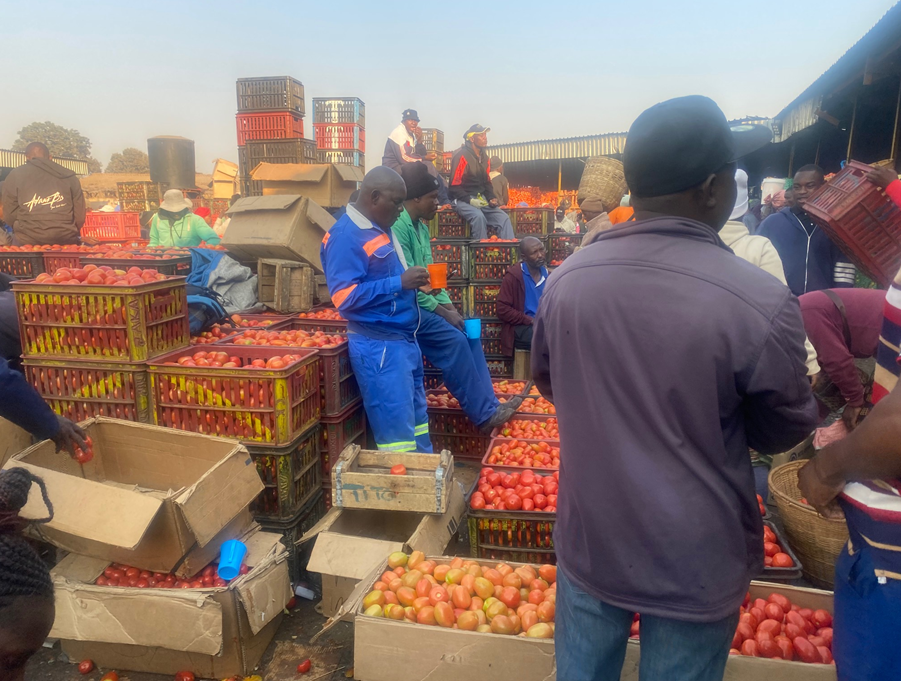
In many African countries, colonialists did not just take the best land for producing their own food and raw materials for their own industries. They went further and used their own language to stigmatize indigenous food so that the young generation of Africans would completely delink themselves from food that is an integral part of their identity. This is visible in the kind of names that were given to indigenous fruits, vegetables and edible insects.
The name given to food influences consumer perceptions
Having found indigenous food without English names, British colonialists in Southern African gave themselves the permission to name diverse foods. Several examples show how the process of giving indigenous food English names was used to undermine local indigenous food. An indigenous vegetable found in Masvingo province of Zimbabwe that is called Deveramvumi in the Shona language and scientifically named Adenia cissampeloides was named Monkey rope by the British who first came across it. Associating that vegetable with a monkey was meant to discourage people from propagating and consuming this vegetable in spite of its nutritious and medicinal benefits.
Another special vegetable called Mushungushungu in Shona (Solanum nigrum) was given the name Black night shade. What has a black night shade have to do with this vegetable? Some of the most insulting English names were reserved to indigenous fruits where a fruit called damba in shona (Strychnos spinose) was given the name Monkey Orange in English and Hwakwa (Strychnos madagascariensis) was given the name Hair leaved monkey orange. As if that is not enough, a fruit called Masakama in Shona (Hexalobus monopetalus) was given the name Baboon’s breakfast and Sekerasikana (Piliostigma thonningii) was given the name Monkey bread. Shuma (Lannea schweinfurthii) was given the name False Marula in English. How can a fruit be false? One of the fruits with the best aroma in African territorial markets Tsubvu (Vitex payo) was given the name Smelly Berry Finger Leaf as if it smells badly. A big share of stigmatizing names was given to African edible insects with many of them referred to as either beetles, grasshoppers or caterpillars. For example, Borohori (Pamphagina lamarckiana) is called a grass hopper in English while Harati (Cirina forda) is called a caterpillar together with Gandari (Gynanisa maia). Ndere (Scarabaiedae sp.) is referred to as a beetle as if it is in the same class with poisonous beetles or the dung beetle.
What does this mean for promoting indigenous food systems?
When indigenous food is given stigmatizing names like Monkey fruit, baboon’s breakfast and beetles, young people are discouraged from consuming it. The battle to promote indigenous food should consider renaming some foods whose English names were meant to wipe away these foods in favour of imported colonial foods which are currently causing several health challenges in African populations. Many indigenous foods are part of African cultural rites and rituals as well as marriage ceremonies like Masungiro in Shona where goats play a key role. Such practices are part of Indigenous Knowledge Systems (IKS) that are at risk of extinction.
Need for solid literature on indigenous food
Besides the fact that some indigenous food has been stereotyped through English names, many indigenous plants do not have scientific names. That makes it difficult to conduct progressive research and development unless the foods are named. While many African communities have abundant knowledge about their local food systems, what lacks are documentation processes that can give such rich knowledge a new lease of life. Developing relevant literature is very important but care must be taken not to dilute community views and perspectives with literature from elsewhere.
When properly supported, communities can document their food systems, name their own foods and develop literature from scratch. The community’s documentation of its own food basket can surface new lessons and identify community aspirations in building growth pathways around their food systems. Ultimately, each documented food basket will become an investment guide for the community. Armed with the investment guide, leaders can position new investors in ways that will lead to easy consolidation of gains from all the investments flowing into the community. It will also reduce the current fragmentation of projects where an NGO can just get into a community and introduce a goat project without clarifying how the project connects with other parts of the local ecosystem. Communities have the right to influence food-related projects that get into their areas as well as govern the collection, ownership, protection, and application of data about their own lives including how their foods are named. If communities are not empowered, external inputs, imported foods and identities will continue to dilute the originality of indigenous foods.
Charles@knowledgetransafrica.com / charles@emkambo.co.zw /
Website: www.emkambo.co.zw / www.knowledgetransafrica.com
Mobile: 0772 137 717/ 0774 430 309/ 0712 737 430