If agroecology is about rebuilding soil health, enhancing biodiversity and reducing dependence on costly external inputs, then African territorial markets are definitely part of agroecology. Territorial markets also show how agroecology is part of indigenous food systems that have sustained communities for generations. By prioritizing food diversity as opposed to narrow supply chains associated with industrial agriculture models, these markets thrive on knowledge co-creation.
Providing pathways for African countries to reconnect with indigenous food systems which had embedded agroecology principles is a key role played by African territorial markets. For instance, traditionally soil healthy was achieved by using of anti-hills and recycling food through multiple purpose uses like converting food leftovers into diverse indigenous beverages and beers. Knowledge was co-created and shared with peers like what happens in territorial markets unlike in supermarkets where farmers just deliver commodities and go back home, leaving the supermarket owners or operators to give the commodities a new identity in the form of its own logo, label and packaging.
Low input and climate-conscious markets
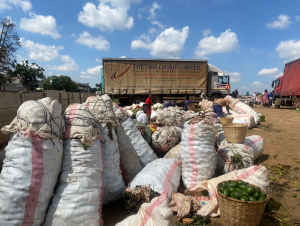
Another key feature of territorial markets that makes them truly agroecology is that they can be defined as low input and climate-conscious markets in a comparative sense. Whereas formal markets tend to be resource-heavy in terms of getting food to the market using big trucks that consume a lot of fuel and setting up expensive market infrastructure that use a lot of energy, territorial markets move food using simple transport and even public transport which does not use a lot of energy. Where formal markets like retail systems need cold storage, warehousing, transport fleets and wholesale distribution systems whose high energy consumption negatively impacts the planet and human life, territorial markets use simple, low-input sheds whose impact on the climate is much less.
For many years, territorial market actors have known that expensive market infrastructure increase the cost of trading and the cost of commodities which end up being passed on to consumers. The downside of building resource-heavy market was revealed in Mbare market of Harare, Zimbabwe where a company was contracted by government to build a market for vendors who were affected by a fire incident in 2024. Instead of assessing the less-resource nature of the original market and learning from traders how they have survived by managing market-related costs, the company built a resource-heavy market shed and started demanding $120 per month as rental fees from traders who were paying $25 to council for decades in line with the value of commodities they trade. The company’s justification for increasing rental fees has been to recover the resource-heavy infrastructure costs. Shunned by intended users, the market has become a white elephant.
Lessons from territorial market governance and operating systems
A lot can also be learnt from less resource-heavy governance systems in territorial markets. Operating the market through market committees is a fundamental way of reducing costs and resources as opposed to employing a board and several managers who all consume a lot of resources. One of the reasons why formal retailers like OK Zimbabwe end up getting bankrupt is the resource-heavy nature of their governance structures. Territorial markets do not hire expensive security companies and prefer to have their own self-organized security system. More importantly, territorial markets do not need very fancy infrastructure and that makes their trading space affordable in ways that avoid passing the costs to consumers. Categorization of commodities, grading and allocation of trading space have inbuilt ways of reducing costs.
Agricultural shows and trade fairs that are an extension of formal marketing systems also tend to be too resource-heavy. Unlike territorial mass markets, event-driven markets like trade fairs and agricultural shows do not capture trends and often promote impulse buying. What also makes them resource-heavy are external forces that compel them to try and measure performance and impact by the number of people who attended the event. Ideally, market performance and impact should be measured by the amount of business generated as well as impact on communities where food and seeds come from. Formal markets also have elements of stage-managing based on assumption on what consumers want. On the contrary, territorial markets show why the market should be self-regulating in terms of pricing, measurements and grades. The best judge of a commodity is the consumer. When formal markets aggregate and put commodities on the market, they assume they know what consumers want. But territorial markets bring together commodities categorized by consumer preferences. What you consider poor quality can be best quality for someone else based on consumer preferences and alternative uses.
Resource-heavy production systems can’t be called climate smart agriculture
While countries like Zimbabwe have sought to use wheat production as an avenue for climate-proofing agriculture, to what extent should a resource-heavy monocrop like wheat be part of climate-smart production when it consumes so much energy, water, fuel to produce, warehouse, process and distribute to consumers? Rather than apply terms like agroecology and sustainable agriculture loosely, policy makers should examine how resource-heavy models they are promoting are. How do we ensure the costs of production and consumption are not heavy? Should each farmer bring his/hr own products to the market? One way of lessening resource use along supply chains and within food systems is building aggregation centres in communities so that moving commodities to the market becomes cheap and not resource heavy.
Charles@knowledgetransafrica.com / charles@emkambo.co.zw /
Website: www.emkambo.co.zw / www.knowledgetransafrica.com
Mobile: 0772 137 717/ 0774 430 309/ 0712 737 430