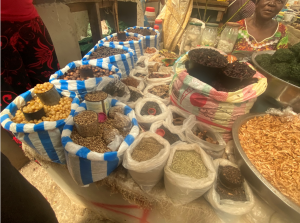
The World Food Program’s 2026 Global Outlook projects 318 million people will face crisis levels of hunger this year and the most affected countries are Afghanistan, Democratic Republic of the Congo (DRC), Haiti, Somalia, South Sudan, and Sudan. Meanwhile, African territorial markets in big cities like Kampala (Nakasero & Nakawa market), Arusha (Kilombero market), Nairobi (Marikiti market), Yaounde (Nsam market) and Harare (Mbare market) are stuck with food which could easily feed all African countries as well as Afghanistan and Haiti. Evidence also shows that most African countries have big production zones that can produce enough food for local consumption and export.
The paradox of abundant food and hunger
How can African countries depend on food aid from other parts of the world when neighbouring countries are producing more than they need? The fact that food losses are high in many countries indicate that production is no longer a challenge but preservation and equitable distribution. Investment in road and railway infrastructure will enable the movement of food across African countries with excess food being exported to other parts of the world. Efficient transportation and warehousing infrastructure will also reveal Africa’s diverse food system to the world and liberate farmers from mono-cropping annual crops that require huge inputs of water, synthetic fertilisers, herbicides and pesticides, and soil tillage. This production system is the root cause of the degradation of soils, water bodies, biodiversity, and most importantly the diversity of the soil microbiomes that are at the root of soil fertility and crop productivity.
Integrating agroecology and sustainable food systems in African markets
Through the African Union, African countries should lobby the World Food Program to procure food intended for humanitarian assistance from African countries that have surplus food. When that happens, many African countries will have a market for their food which, besides being culturally appropriate for most consumers, is produced in more sustainable and climate-friendly ways. It will also become easy to integrate agroecology and sustainable food systems into African communities and territorial markets that are currently being contaminated by food from outside the continent.
Africa’s food basket is already diverse in ways that ensure balanced nutrition. Contrary to the one-size-fits-all meals provided as food aid, the African food basket is made up of simple food, dishes, processed foods and beverages. Engaging communities can easily show the journey travelled by agroecology commodities and sustainable foods from raw state to finished products.
Simple AE foods – For example, most indigenous fruits and tubers are consumed in a raw state and when they are out of season they are not found.
Dishes – How are the fruits getting to dishes? A lot of indigenous knowledge can be expressed in dishes. To what extent are agroecology products being used as dishes in communities and markets where there are conventional dishes? How much of our own commodities are used in daily dishes? Such questions can be answered in African communities.
Beverages – how many small grains, tubers and indigenous fruits are being processed into beers, wines and juices? There is competition from industrial beverages. What support is needed to make agroecology products trade as beverages?
Processing – How many agroecology products and sustainable foods are being processed into various products? To what extent can agroecology be integrated in territorial as processed products?
The power of dialogue around local food baskets
Dialogue sessions with African communities in high production areas can answer most of the above questions using their current food baskets. If the mapping and discussion shows that 90% of indigenous and agroecology food is at simple food category, what is the implication for value addition and nutrition? If there are only two dishes, what is preventing indigenous fruits and tubers from finding their way into beverages and other dishes? How much agroecology entrepreneurship is happening at different food basket nodes? This can reveal the extent to which industrial food systems are threatening agroecology and sustainable food systems. For instance, how are Irish potatoes threatening cassava? Threats and competition from industrial food systems can inform strategies for integrating agroecology and sustainable food systems in territorial markets.
The fact that African territorial markets are good at aggregating food baskets from diverse communities, means they can be an appropriate avenue for integrating community-built food baskets so that other countries can get what they need at the time they need it. Besides creating marketing pathways for indigenous food, this will also build a unique identity for African communities and their food baskets. The growth of the food basket template in the market is an indication of surplus commodities in production areas which can be exported to other countries. The current food basket can be a starting point toward tracking substitutability and change in mindset which will then trigger more production of agroecology commodities. This approach can inspire new careers around African food systems which are currently missing in the humanitarian food basket. African food baskets can also become an integral part of content in education systems especially when communities are engaged to surface relevant knowledge about their food systems. Diverse food baskets exist in many African communities but they have not been documented. Meticulous documentation will lead to a monitoring systems and investment guides showing entry points for agroecology entrepreneurship that eventually replace imported food with African foods.
charles@knowledgetransafrica.com / charles@emkambo.co.zw /
Website: www.emkambo.co.zw / www.knowledgetransafrica.com
Mobile: 0772 137 717/ 0774 430 309/ 0712 737 430