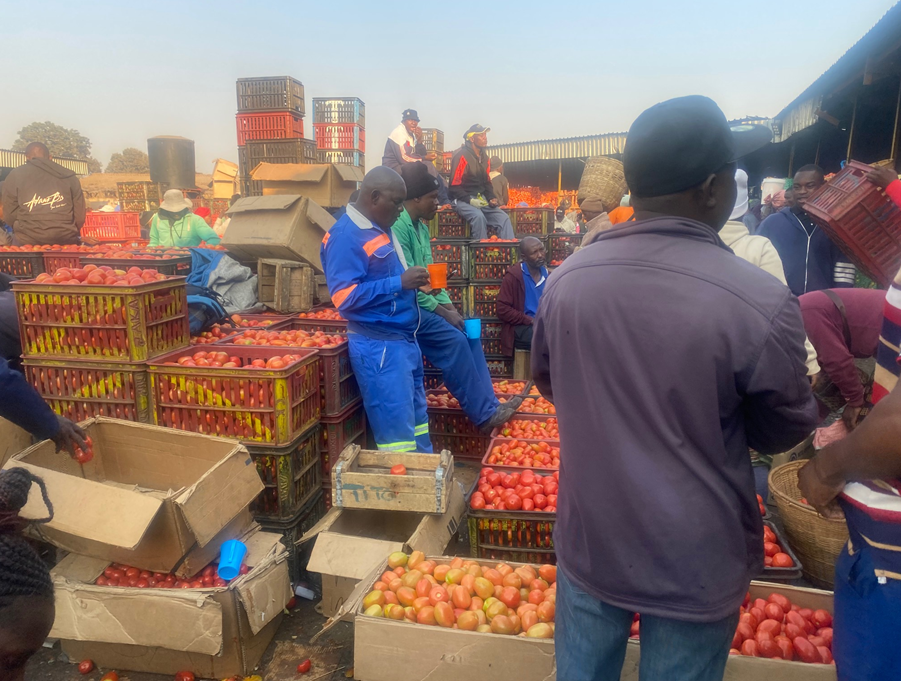
Absence of institutional support and fluid data has persistently seen most African agricultural value chains invaded by opportunists who end up taking the bigger cake from the total value of agriculture. These opportunists also take away proceeds from agriculture to other sectors like real estate, mining and the fuel industry. Some opportunists use their financial muscle to withdraw money from local supply chains and use it to import commodities that are abundant locally in marginalized communities. For instance, they can import groundnuts and sugar beans that might already be abundant in some parts of the country. Those imported commodities put pressure on local prices of the same commodities and undervalue local agricultural resources. Local commodities end up being considered sub-standard and not worth to be supported by banks.
Digital technologies are concentrated on the production side
Most African countries are lagging behind in using digital technology to strengthen agricultural supply chains and food systems. Much of the technological investment on the production is not being extended to logistics, marketing and distribution of more than 100 food commodities of which more than 70% are produced by smallholder farmers. Logistics, marketing and distribution processes are still using traditional methods like physical movement of food physically looking for markets and physical determination of price-setting. This renders most supply chains more resource-heavy as farmers spend more time looking for buyers and time in the market trading commodities.
The same applies to processors and aggregators of commodities like small grains who incur huge aggregation costs. The resource-heavy nature of supply chains makes commodities unaffordable to many consumers and uncompetitive on the export market. When farmers produce without market intelligence in terms of what buyers want, when and in what quantities, markets end up with gluts from unsolicited commodities which under-value commodities and lead to low prices for farmers. Given that different agroecological regions and climate conditions are suitable for different value chains, some regions end up producing in excess with no systems connecting such regions with deficit areas. The resulting information asymmetry oppresses farmers.
Pitfalls of undocumented trading patterns
The fact that much of the trading in territorial mass markets like Mbare in Harare and local communities remains undocumented means farmers and traders lack trading history that can be used for accessing finance. Without trading records farmers are exploited by opportunists who can easily register companies and fulfil all requirements prioritized by formal financial institutions that are mostly interested in assessing paperwork than appreciating the actual work by farmers on the ground. Data on hectares planted and harvests is often available on the production side but data on how much has been sold are missing. Yet sales records are key in showing the value of agriculture and contribution to the fiscus. Why is the value of tobacco only expressed in exports? Why are records for internal trading of diverse commodities missing? For instance, what is quantity of cabbages and potatoes traded in the local market and what is the value in monetary terms? How much are communities getting from indigenous fruits? How many tons of small grains and indigenous fruits are going into processing? Data to answer these critical questions is available with different opportunists and traders but not consolidated enough to build a complete national picture.
Lack of aggregation and concentration of farmers in local markets
The absence of supportive distribution systems has seen most smallholder farmers confined to local markets where they compete among themselves. This is also exacerbated by lack of aggregation systems in most production areas. The same applies to government irrigation schemes and Village Business Units (VBUs) that have capacity to produce a lot of commodities but lack information on what to produce, for who and in what quantities? When information between VBUs, irrigation schemes and dry land farmers is uncoordinated, they compete with each other for the same consumers.
Many territorial mass markets aggregate commodities mostly for unknown buyers who show up indiscriminately because market lacks consolidated information on what commodities are coming to the market from where? That is why systems that identify farmers and aggregate commodities before commodities are moved to the market are badly needed. At the moment, consumers and genuine buyers looking for commodities lack information on where to get the commodities without going through opportunists. This can be addressed through an institution or platform set up to strengthen the relationship between distant buyers and farmers at very minimal costs. Such an institution can also auction commodities so that they get the best value. If 30 tons of sugar beans are posted onto the platform, that consignment is available to the whole world and the best offers will come from anywhere. This can broaden the market for commodities. Commodities demanded by buyers guide farmers what to produce, when and for whom – helping farmers to accurately respond to demand. That way, production is tailored to meet market expectations and standards in ways that bypass opportunists and kills opportunism.
The value of consolidating information and knowledge
Another big challenge is that in most African countries information is siloed in individual farmers, extension officers, traders, transporters, processors, aggregators and diverse NGOs working in the agricultural sector. There is no consolidated information system for improving the efficiency of agricultural supply chains. An institution responsible for monitoring and evaluating the movement of commodities from production areas to markets will show quantities available at any given time. Such a tracking system will give the nation real time early warnings about the state of the agriculture sector and food systems. At the moment such a system does not exist as seen by how farmers do their things as individuals, traders have no tracking system and extension officers have no idea which farmer has sold what to who and for how much? When carefully captured information from the market should be continuously updated to show how much has been harvested and as farmers trade, the stocks will be run down, with volumes also revealing a particular community’s resilience. Besides destroying opportunism, consolidating market information and knowledge will facilitate fair trade. Why should a farmer be locked in a price at planting when prices can change by the time trading commences? Broadening the market space can provide diverse options that also improve pricing systems in order to bring better value for commodities and increase Return on Investment for farmers and the entire agriculture sector.
Charles@knowledgetransafrica.com / charles@emkambo.co.zw /
Website: www.emkambo.co.zw / www.knowledgetransafrica.com
Mobile: 0772 137 717/ 0774 430 309/ 0712 737 430