
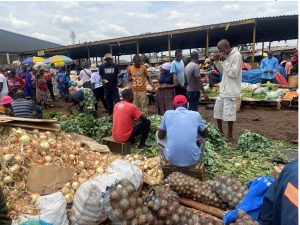
Being self-organized for decades has enabled most African territorial markets to write their own socio-economic rules in ways that are contrary to formal systems that African governments borrowed from colonialism without questioning. For instance, whereas formal business often at 8am and close at 5pm, most African territorial markets operate 24/7 with restocking happening throughout the night until 3am. Territorial markets in big cities like Lagos, Dakar, Cairo, Addis Ababa, Kampala and Harare open at 4-5am. By 7am the market has settled in terms of pricing for the day. All these processes are led by farmers, traders and market committees, not by government officials. Whereas formal systems are fussy about using kilograms and litres to value commodities, territorial market trading rules have broadened the measurements to include local bags, tins, clay pots, gourds, bags, crates as well as human-centred measurements like senses of touch, smell, taste, smell and sight.
Toward new forms of resilience and growth-oriented middle-class markets
Through territorial markets, communities are enhancing their resilience by seeing information on their performance especially in the market. For instance, data from territorial markets is beginning to show income generated by previously marginalized crops like small grains and indigenous fruits such as baobab. Although farmers sell small volumes like buckets individually, collective information like the total volume from their community is showing their collective power as a big source of diverse food, more than they could imagine at individual level. Data collection is also showing the value of the market through volumes and prices toward supporting the agriculture sector and livelihoods.
Evidence from most African territorial markets is revealing the need for growth-oriented middle-class markets between territorial markets and supermarkets or wholesale markets. The new middle-class market would make possible the setting up of new relevant local standards built from the best of existing markets. Currently, there are big gaps between territorial markets and formal markets to meet the expectations of consumers who prefer a market that combines the good side of both informal markets and formal markets like supermarkets. When both territorial markets and super markets fail to meet some expected standards of boarding schools and hotels, there should be a middle-class market to satisfy such standards and expectations whose rules are yet to be codified.
While territorial markets have killed the wholesaling model in some African countries, such a model is proving critical for many smallholder farmers. When carefully set up within territorial markets, a wholesale can be a granary that allows small grains farmers to sell slowly as prices improve unlike handling over commodities to middlemen for a song during the harvesting season. Non-perishable can be put in the market which will now function as the wholesaler for traders. Practices in territorial markets recognize that if farming is a business, farmer should operate 24/7 like other businesses.
Evolution of a much stronger grapevine
Years of neglect by elected officials like members of parliament and councillors have strengthened territorial market actors like farmers and traders to take their life matters into their hands with the full realization that they are on their own. If members of parliament and councillors really cared about farmers, traders and food systems, territorial market infrastructure would not be as dilapidated as is the case in most countries. Failure to address market issues is leading to declining trust in elections as farmers, traders and ordinary have been left to solve their problems for decades.
Functioning as a self-contained economy that is separate from the formal economy has seen territorial markets and informal sectors creating their own grapevine communication system which is fast being strengthened by social media. Very few traders trust what they read in official newspapers or hear on national radio, preferring to rely on their own social media-driven grapevine.
These processes are quietly shaping how traders and other actors in the informal economy legitimize authority. The previously dominant information regime which determined who can speak, organize, and mobilize is being silently challenged. A new socio-economic system that is trusted by farmers, traders and ordinary people who buy commodities from territorial markets has been reconstructed outside formal authority with the help of social media. In fact, territorial markets and the informal sector have out-grown institutions that were built for the formal economy. Coordinating food systems is no longer a preserve of the elite and experts who have absorbed colonial knowledge. The increasing power of territorial markets is hastening the collapse of gatekeeping institutions like agricultural marketing authorities.
Need for priority investment in territorial markets and local skills
Some of the lessons emerging from territorial markets include the fact that agriculture-based economies need to prioritize long-term investment in territorial markets in order to steer formal job creation, anchored by strategic planning. You can’t build an economy using informal hand to mouth systems. Farmers are local investors but they lack support from other stakeholders. They have crops in the field from which they want to meet school fees and other needs. Had they been paid for last year’s crop, they would meet their needs. Commercial farming has a thin food basket but smallholders have a diverse food basket although they lack formal support from government.
Understanding the skills landscape can also provide directions for African countries to build new economies based on new post-colonial skills bases that are much stronger as demonstrated by territorial markets and the informal sector. The cost benefit analysis of importing finished products versus producing local products is enormous for most African countries. African parents and guardians have invested in education but their children are importing second hand clothes and groceries for sale. Deep analysis can answer questions like: What are the implications of not recognizing and institutionalizing skills that are driving local economies through territorial markets and MSMEs? Skills that are being institutionalized through formal education systems are far from responding to the reality on the ground. Territorial markets and MSMEs have proven their ability to position skills and knowledge along supply chains – farmers, traders, transporters, men, women, youth and the differently abled.
Charles@knowledgetransafrica.com / charles@emkambo.co.zw /
Website: www.emkambo.co.zw / www.knowledgetransafrica.com
Mobile: 0772 137 717/ 0774 430 309/ 0712 737 430