
Most conversations about food systems and climate change that happen in global conferences and capital city workshops continue to miss practical community voices. When a few community representatives are invited, the purpose is mostly superficial for legitimizing the event through media coverage. In some circumstances, development organizations get into a community and introduce a goat project or horticulture project without conducting a thorough baseline survey and clarifying how such projects enhance the local food system. Consequently, sustainability is undermined when goat breeds brought from outside begin to under-perform and imported hybrid vegetables contaminate indigenous vegetables.
The value of understanding local food baskets
Food systems and climate adaptation interventions cannot make a difference without detailed information about the local food basket. Unfortunately, high level discussions on climate adaptation rarely try to find out how local food baskets can make climate finance more meaningful. Obtaining such crucial intelligence requires working with communities in developing a framework that recognize knowledge around local food baskets. In a turbulent world characterized by climate change, unhealthy food and wars, it has become fundamental for farming communities to have in-depth knowledge about their food systems, biodiversity and medicinal plants. Through grounded dialogue, communities can realize how many of their crops and livestock are threatened by extinction and how many are withstanding climate variability.
Key missing voices
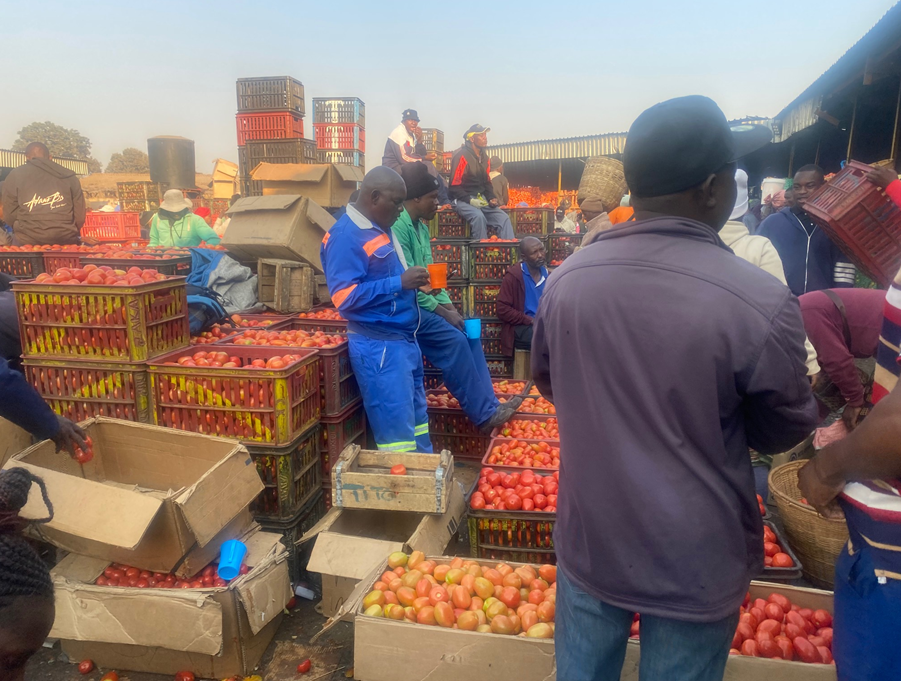
While few farmers are sometimes consulted especially at the beginning of projects, traders are some of the most important food system actors whose views are totally ignored. Yet traders who source commodities from diverse production areas can provide valuable information critical for programming. For instance, traders know the seasonality of different areas, volumes and difficulties around transporting commodities from certain areas. Without such intelligence government, contract companies or development organizations can introduce a project whose commodities will face difficulties at the market or can be out-competed by what is coming from other areas. This is how the cost of by-passing traders can be huge.
In some cases, communities have their own expectations based on how they understand the local food system. For instance, they may want a particular project to cover the whole district in order to capture micro climates that produce food which cannot be found in some villages. Going through each food category, communities and traders can determine which are the simple foods, dishes, beverages and how simple or difficult some foods are to trade in the market depending on whether their compliments are also available or not. For instance, cauliflower is easier to sell when accompanied with broccoli. Traders also know the cost of fuel. packaging, bags, strings, loading, off-loading, security and other marketing costs such as theft and shrinkage. All these details are critical in framing climate change and food systems interventions.
Some of the challenges that can be identified through community consultations
Humble conversations with communities can reveal limited production of indigenous food and how there is very little documentation about indigenous food systems. In that case, there might be more value for a project to start building the food literature from working with the communities, most of whom have abundant knowledge. Key trends can be captured through a longitudinal study over 12 months leading to a comparative analysis. Even if there are two seasons, some commodities harvested in the rainy season are preserved for consumption during the dry season. Interesting questions would include how much would consumers eat Nyevhe if it was available in a fresh state the whole year? A longitudinal study can provide space for a comparative analysis that answers such questions. A major challenge with most indigenous food is that it has a very short shelf life when in season. By showing the amount of food from different districts, mass markets can reveal opportunities for value addition and food preservation in those districts.
The role of culture and rituals
A lot of African indigenous food is associated with cultural rites, myths and rituals. Some food is used during traditional ceremonies and marriage customs. These practices are part of Indigenous Knowledge Systems (IKS) that are often not considered a resource by development organizations. When governments and development organizations talk about resources, they mean raw materials used to build dams, irrigations schemes, bridges, roads and warehouses. Knowledge, practices and positive attitude and IKS brought by local people which will be used in using and sustaining the resources are not considered important resources. On the other hand, some churches are demonizing indigenous food in ways that undermine production and consumption of such foods. Thankfully, territorial mass markets are preventing the extinction of some indigenous food by providing a consistent demand pattern on the market. These markets are also creating space for traditional tools such as those used to thresh and roast small grains.
Indigenous food as a foundation for future industries
Development interventions should also recognize how indigenous fruits like Matohwe, Masawu Mawuyu as well as vegetables like Nyevhe are foundations of future industries. Instead of continuing to promote exotic fruit plantations, African governments should start advancing the cultivation of indigenous foods. Conversations can start with finding out from the community how they define food as indigenous or exotic from their own perspectives. Local elders may mention exotic food as that which came with missionaries as part of colonization. Communities can also collectively list their food including how it is produced as well as trends around their food basket. For instance, is the food basket expanding or shrinking?
By demonstrating demand and consumption patterns, mass markets can show if particular food baskets are expanding or shrinking. Communities can also reveal the extent to which the production of indigenous food is matching consumption or whether production is inconsistent in ways that affect demand patterns. Such conversations provide the community with an opportunity to enrich the intervention by semi-processing data and giving their own positions and consensus. Depending on facilitation, dialogue sessions can be practical and meaningful ways of analysing data. Communities can share emerging trends as well as internal or external factors affecting local food systems and support required to cope with climate change.
Charles@knowledgetransafrica.com / charles@emkambo.co.zw /
Website: www.emkambo.co.zw / www.knowledgetransafrica.com
Mobile: 0772 137 717/ 0774 430 309/ 0712 737 430