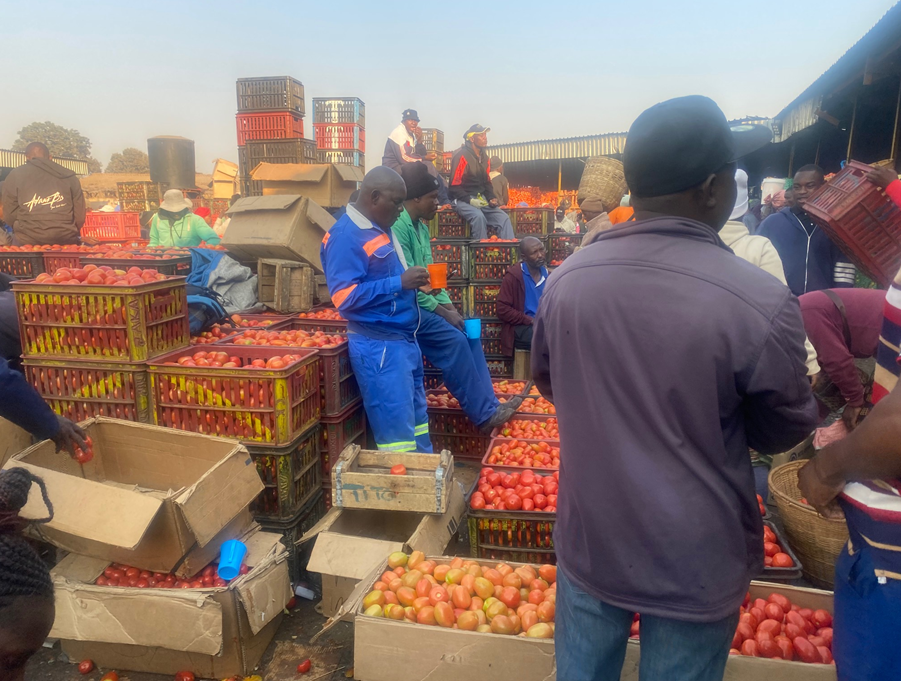

By bringing diverse commodities and people together across boundaries, African mass markets create space for issues that are usually left unsaid. While the formal mainstream media is more interested in what is happening right now, mass markets bring people together to discuss what and who is causing what is happening. For instance, mainstream media can be satisfied in reporting that food prices have gone up due to the high cost of inputs. Farmers and traders in mass markets want to know who is profiting from this situation, and what is allowing such profiteering and who is getting away with such behaviours. These political economy questions are not asked by mainstream media.
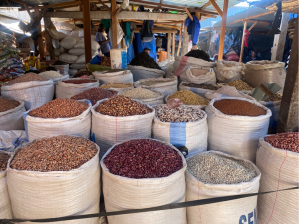
Political power is marginalizing indigenous food
African mass markets do not just show how broad and deep a country’s food system is. They also show how political power influence which food is marginalized and who benefits from the way things are. That is the political economy of food systems not often taken seriously by most people. Political economy is about how politics affects the economy and the economy affects politics. Who benefits from the national focus on industrial agriculture and who loses? Mass market actors are also keen to know how political institutions, economic policies and social structures like parastatals interact to shape the production, distribution, and consumption of food in the country. Power dynamics between farmers, traders, financial institutions, seed companies, equipment manufacturers, big processing companies and shopping malls are also quietly examined by mass market actors. They are also worried about costs of a broken food system which include cancers, deforestation, pollution, water scarcity, poverty and malnutrition which are increasing in most farming communities.
Why does indigenous food not receive the attention given to imported hybrids?
This is another fundamental political economy question discussed in most African territorial markets. Policy makers support imported hybrids from production to marketing but the same is not happening for indigenous food whose production and marketing remains informal. For instance, Mutsine (black jack) and Nyevhe grow naturally as weeds during the rainy season. They often get muddy during downpours because they are close to the ground. Munyemba and all these vegetables do not get the attention they deserve. They are mainly ground growers and therefore exposed to mud and dust. Highly informal production leads to contamination by many impurities including soil that may not be removed adequately in the cleaning process.
Harvesting is merely picking with no basis for grading because they are not produced with commercialization in mind. They go to the informal market where there is no emphasis on traceability so that consumers would probably lodge a complaint regarding quality and cleanliness. After picking there is not much hygiene in the processing stage. Mutsine and Nyevhe leaves are too small and very difficult to clean. Since the market and consumption has not been formalized there is no feedback to producers in terms of: “Don’t pick mutsine bottom leaves that are exposed to too much mud.” In Munyevhe emphasis should be on cleaning.
Whereas in peas and other commercial vegetables there is emphasis on thorough grading, indigenous vegetables whose sizes are bigger than peas are not being supported to become a commercial crop so that farmers can be educated properly including how to raise the crop and mulch so that there are minimum impurities from the ground. While the benefits of these vegetables are known and go beyond nutrition, policies do not support them to be an important part of on-farm economic activity for rural households. The good thing is that most indigenous vegetables are very easy to commercialize. They grow on their own during the rainy season with no need for irrigation, fertilizer or chemicals. They can be considered authentic organic, the direction in which the world is going. Some don’t even need seed, for instance, Nyevhe and Mutsine whose seed like dormant in winter and germinate naturally with the first rains. Political will can change the fortunes of these important components of indigenous food systems.
Mass markets show the big picture
The diversity of commodities and food baskets pulled together by mass markets and related conversations can show how current African food systems are unsustainable, inequitable, and unhealthy. The composition of the food basket shows the interests, the institutions, the policies and the relationships that have shaped – and continue to shape – what farmers grow, why and how they grow particular crops at the expense of indigenous food. Mass markets show the big picture in terms of who controls local food production and distribution. It’s not an accident that so many aspects of farming, agricultural trading, and food retail are dominated by a handful of corporations.
Charles@knowledgetransafrica.com / charles@emkambo.co.zw /
Website: www.emkambo.co.zw / www.knowledgetransafrica.com
Mobile: 0772 137 717/ 0774 430 309/ 0712 737 430