
Formal institutions do not have the data required to build African economies
The amount and quality of data required to transform African economies cannot be found in statistical agencies, universities, reserve banks or any government institution alone. For agriculture-driven economies, value chains, farmers and mass markets possess the data badly needed for reality checks. To deliver on the full promise of supporting economic progress, financial institutions and value chain actors need unprecedented amounts of data which no single organization can collect. In addition, there is need for new methods, talents, capabilities and infrastructure to gather and process the data. AI can’t do it.
Making sense of complex socio-economic issues
Socio-economic issues in most African countries are too complicated and the amount of data too vast for any one institution to generate. Government departments may try to over-simplify the reality on the ground through periodic news coverage of high-profile project launches. But no single institution has the right number of smart people to figure everything out. No community or financial institution has the right number of smart people to fully understand the hybrid, fast-moving economy driven by relationships and networks quietly nested on digital technologies. Farmers and ordinary people who were previously conditioned to think that useful information has to be sponsored by a corporate organization like a bank, a seed company or a telecoms company are now making sense of their socio-economic realities through real-time and unbiased insights from their networks operating through mass markets.
When 70% of African food systems are driven by smallholder farmers and SMEs, how can African economies tap into mass markets to create employment for diverse graduates so that they can develop career paths? Those who studied supply chain and logistics should find a career in mass markets, the same applies to agricultural economists whose vital skills are needed in mass markets. Statisticians and food scientists should also be present in mass markets not in the laboratory. All these experts should bring their knowledge, passion and expertise to understanding and institutionalizing this unique industry toward opening opportunities like value addition and digital extension.
Building a new culture of gathering evidence
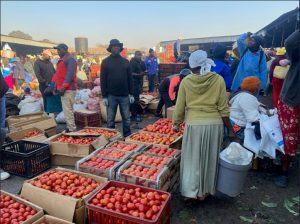
Riding on a new culture of gathering evidence, value chain actors are now collaborating on a new scale that was unimaginable a decade ago. Gone are the days of academic researchers acting like sole proprietors, building their own teams, raising their own money and focusing more on personal recognition. It no longer pays for private companies to jealously guard their secrets, for fear of being beaten in the market. Evidence gathering now needs a new kind of organizational culture that is open to collaborating even with competitors. When commodities are in the mass market, they assume new identities detached from the way seed companies name their varieties. One green maize seed variety is now called Kasa Banana in Mbare market. Unless agronomists and researchers who bred this variety visit the mass market, they won’t know this new name which is more creatively marketing-oriented.
Using market evidence to characterize farmers
Formal institutions like ministries of agriculture have their own ways of characterizing farmers but markets have their own ways of doing so based on individual farmer participation in the market. One can be a smallholder farmer consistently participating in the market. Another farmer can focus on seasonal field crops. Building on evidence from African mass markets, factors that can be used in categorizing farmers include: seasonality; frequency of market participation; commodities and volumes. At community level the best characterization can be around collective surplus – how much surplus does the community produce for the market? It is difficult to characterize individual smallholder farmers through production alone because high volumes of production may not translate to surplus for the market. If a family is large, subsistence consumption can be more than 80% because the farmer may have more mouths to feed. On the other hand, a small family can produce three tons and consume one ton with the rest going to the market.
The mass market as a laboratory
Government departments, development agencies and academic institutions may find the notion that mass markets are living laboratories laughable. But that is what these markets are. For over a decade, eMKambo has been gathering evidence from mass markets daily and helping value chain actors to pool their data. It has also been building the capacity of farmers, traders and vendors to interpret evidence. These actors are now curious to gather more information behind commodity prices. For instance, why is a crate of tomatoes that was going for $45 yesterday fetching $38 today? This is how another avenue for injecting economic and scientific thinking into ordinary people without putting them into a classroom. The mass market itself is an open classroom and laboratory where farmers, traders, vendors and consumers collectively make sense of knowledge. If market actors were to be taken to classrooms or lecture halls, the population would starve because there would be no food in most households.
Social media is accelerating farmers’ confidence in the current age of experimentation where individuals are taking control of their learning and work in order to be creative. Some of the farmers and traders keep this information to themselves and use it privately to make decisions. Seed companies, farmer organizations and policy makers should invest in accessing such feedback if they are to remain relevant.
Charles@knowledgetransafrica.com / charles@emkambo.co.zw /
Website: www.emkambo.co.zw / www.knowledgetransafrica.com
Mobile: 0772 137 717/ 0774 430 309/ 0712 737 430