
Once farmers start participating in the market, they no longer remain the same. By talking to other farmers and listening to experiences from other parts of the country, they stop being passive price-takers. They become active co-creators of the marketing experience. Through the mass market, farmers find their voices by exchanging phone numbers and sharing vital information without seeking permission from middlemen. This is how mass markets and mobile technologies are changing the behavior and character of many farmers in ways that policy makers and financial institutions may not know.
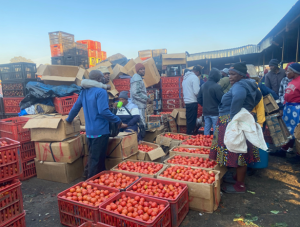
Farmers quickly spread their bad contract farming experiences with peers. Banks, contract companies and parastatals wonder why few farmers embrace contract farming. The farmers silently black list bad middlemen while spreading good words about honest middlemen.
Using data to anchor farmer characterization and commodity mapping
It is by working with mass markets that policy makers and financial institutions can harvest critical market insights that guide farmer characterization. Such intelligence also assists in making sense of commodity demand and supply patterns. From how the are using digital technology to master market functions, farmers are proving that digital platforms are no longer just about providing information to farmers and other value chain actors but ensuring reliable supply of agricultural commodities where they are needed. Some of these pathways are buy-passing formal and informal markets. Regular collection and analyses of data from agricultural markets (formal and informal) is fast becoming the basis for aggregating reliable food demand and supply models. That process also builds a sustainable evidence-based culture. For instance, the following knowledge sharing pathways have been identified: farmer to farmer; farmer to trader; trader to farmer; trader to trader; farmer to transporter; transporter to farmer; trader to transporter; consumer to farmer; consumer to trader; trader to financier and many others.
Relationships, trust and growing virtual markets
Relationships and trust are supporting the movement of food before payments are made. Value chain actors have come to terms with the fact that unless relationships enable commodities to move three quarters of the supply chain before money is transferred, everything will remain on a cash basis and that limits value creation in the agriculture sector. These new practices are challenging conventional brick and mortar models that are based on constructing expensive markets. Investors are beginning to realize that quick movement of food does not require investment in sophisticated resource-heavy markets. Instead, there could be need for investment in commodity ripening and holding facilities such as movable containers.
More virtual markets are beginning to emerge, thanks to big data and social media. For instance, bulk commodities like maize, sweet potatoes, sugar bean can easily be traded on virtual markets. Big data is also enabling the integration of fragmented land-holdings in ways that influence what can be produced for who and in what quantities. By collecting market data which shows where commodities are coming from, we can tell which land, water and other resources are being used productively in particular districts.
When farmers don’t aggregate their commodities, they can’t take advantage of good prices
The market is the one which should indicate production corridors from which surplus comes to the market. By strengthening diverse local markets, pressure is relieved from mass markets which are currently becoming congested. Such e-commerce platforms ride on existing relationships along which food is already moving from one region to another without passing through formal or informal markets where double handling can compromise value. On-farm production figures may mislead because some communities may be consuming 80% of their production with nothing left for the market, especially if they are producing their staple commodities.
Without data, financiers may not know the extent to which farmers are stuck with commodities that need a market. Financiers that go ahead to finance production when farmers still have commodities end up y incentivizing the misuse of loans. Farmers will simply use that money to subsidize market failure. Paying attention to data and knowledge can reduce farmers’ costs of production in various ways including record keeping and budgets including costing. Farmers who are keeping digital records are now able to generate scenarios. For instance, if the price of sweet potatoes is $3 per bucket, what does it mean in terms of cost? Farmers have to seat down and come up with cost plans and projected plans. How can farmers minimize costs through economies of scale? How much land can a farmer devote to a particular crop to get good returns? There are benefits from a particular piece of land. Monitoring economies of scale is also critical from a transportation angle. For instance, travelling three tips using a one-toner truck compared to one trip with a 7-toner over 100km. This provides benefits to economies of scale. Economies of scale also apply to information-seeking behavior. Rather than looking for market information individually through mobile calling, costs may be reduced through collective marketing which saves airtime. Farmers can also reduce economic losses related lower prices by understanding records and following market-oriented production calendars that inform when to produce and for who.
Charles@knowledgetransafrica.com / charles@emkambo.co.zw /
Website: www.emkambo.co.zw / www.knowledgetransafrica.com
Mobile: 0772 137 717/ 0774 430 309/ 0712 737 430